
Somewhere in the Southern Ocean, in water hovering just above freezing, swims a fish with blood you could see through. No red blood cells. No hemoglobin. Cut it, and what flows out looks more like watery plasma than blood. This is the icefish, the only group of vertebrates on the planet that lives without the oxygen-carrying protein nearly every other animal with a spine depends on.
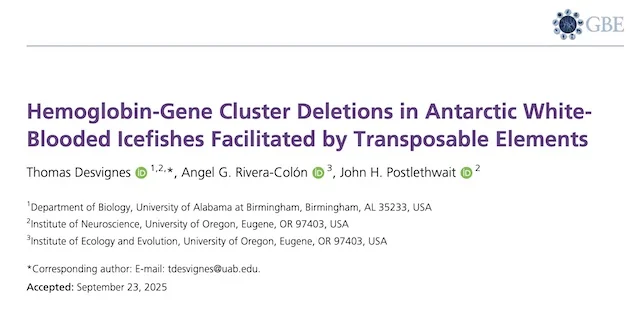
Biologists have known about icefish for decades, but the deeper question of how they lost hemoglobin at the genetic level has remained unresolved. A study published on 25 September 2025 in Genome Biology and Evolution by Thomas Desvignes, Angel G. Rivera-Colón, and John H. Postlethwait finally traces the molecular events behind this loss, and it turns out the two genetic regions that once coded for hemoglobin were wiped out by two completely different mechanisms, both driven by mobile stretches of DNA called transposable elements.
Meet the only vertebrates with colorless blood
Icefish belong to a group of Antarctic fish called notothenioids, most of which have red blood in the ordinary vertebrate sense. Somewhere around 5.3 million years ago, after icefish split off from their red-blooded dragonfish relatives, something happened to the ancestral genome that erased nearly every hemoglobin gene it carried. All that survives today, in most icefish species, is a single leftover exon: a fragment of one alpha-globin gene, non-functional and stranded in the DNA like a fossil.
Without hemoglobin, icefish carry only around a tenth of the oxygen that red-blooded relatives of the same size manage in their blood. To make up for it, their bodies compensate dramatically: hearts up to five times larger, a far denser network of blood vessels, and cells packed with more mitochondria than usual. It is, functionally, a full-body redesign built around a missing protein.
How transposable elements deleted two hemoglobin gene clusters
Vertebrate hemoglobin genes sit in gene clusters, and teleost fish like icefish carry two of them, known as the LA and MN clusters. Researchers compared these regions across ten red-blooded notothenioid species and eight icefish species, and found that each cluster was lost by its own distinct route.
The LA cluster region tells a story of runaway tRNA multiplication. In ordinary fish, this stretch of DNA runs to a few dozen kilobases. In red-blooded Antarctic notothenioids it swells to several hundred kilobases, packed with hundreds of transfer RNA genes that have proliferated alongside transposable elements. In the icefish ancestor, one particular cluster of these elements and tRNAs, nicknamed the “tRNA-TE unit” by the study’s authors, inserted itself just 136 base pairs from the remaining hemoglobin exon. The genomic sequence lines up almost perfectly with red-blooded relatives up to that exact point, then simply stops. Everything downstream, the working hemoglobin genes, is gone.
The MN cluster took a different path entirely. Rather than a wave of tRNA expansion, the researchers found a dense block of transposable elements bookending a stretch of DNA that has no counterpart in red-blooded species at all. The alignment between icefish and their red-blooded relatives breaks off cleanly on both sides of where the hemoglobin genes used to sit, replaced by an entirely new, transposon-rich sequence that later kept evolving independently in each icefish lineage. The genetic fingerprints suggest this cluster wasn’t gradually eroded so much as swapped out in one event, likely as the mobile elements moved through the genome.
Why losing hemoglobin might not have been fatal in freezing water
What makes this loss so puzzling is that hemoglobin matters more, not less, in the conditions icefish inhabit. Cold slows metabolism and should make an oxygen-carrying protein more valuable, not optional. Yet icefish have persisted for millions of years without one.
Part of the answer may lie in simple physics: cold water holds more dissolved oxygen than warm water, so icefish blood plasma alone can carry more oxygen than it would in a temperate sea. Experiments on related notothenioid species reinforce the point. One species survives with its hematocrit cut by 90 percent; another can tolerate having the vast majority of its hemoglobin blocked by carbon monoxide poisoning and still recover. Some red-blooded Antarctic fish already carry a sixth of their oxygen dissolved directly in plasma rather than bound to hemoglobin. If the icefish ancestor was already running on a thin physiological margin, hemoglobin loss may not have been catastrophic so much as survivable, in a way it never could be in warmer water.
What extreme cold adaptation in icefish reveals about the limits of physiology
Icefish sit at an extreme edge of vertebrate biology, a case where an entire organ system’s worth of function was deleted and the body rebuilt itself around the gap rather than around the missing part. It joins a small set of animal case studies, alongside cold-water diving physiology in seals and the metabolic adjustments seen in cold-climate mammals like moose, that show how differently a vertebrate body can be configured when temperature, not just genetics, sets the terms.
The icefish genome doesn’t explain why evolution allowed this to happen, only how. Whether the loss was ever actively favorable, or simply survivable enough not to be selected against in a cold ocean with little competition, remains an open question. But the mechanism is now, for the first time, written into the DNA in detail: two separate genetic accidents, both driven by mobile elements, that quietly rewired what oxygen transport means for an entire vertebrate lineage.
Humans, of course, are not on a similar evolutionary path — a few generations of cold exposure will not rewrite our biology. But the icefish offers a fascinating reminder of just how much time evolution has to experiment. Whether millions of years of cold exposure could ever nudge the descendants of today’s Wim Hof practitioners toward anything resembling the icefish’s evolutionary path remains delightfully unclear — evolution, unlike a cold plunge, isn’t in a hurry.
Source: Desvignes T, Rivera-Colón AG, Postlethwait JH. “Hemoglobin-Gene Cluster Deletions in Antarctic White-Blooded Icefishes Facilitated by Transposable Elements.” Genome Biol Evol. 2025 Sep 25;17(10):evaf184. doi: 10.1093/gbe/evaf184


